
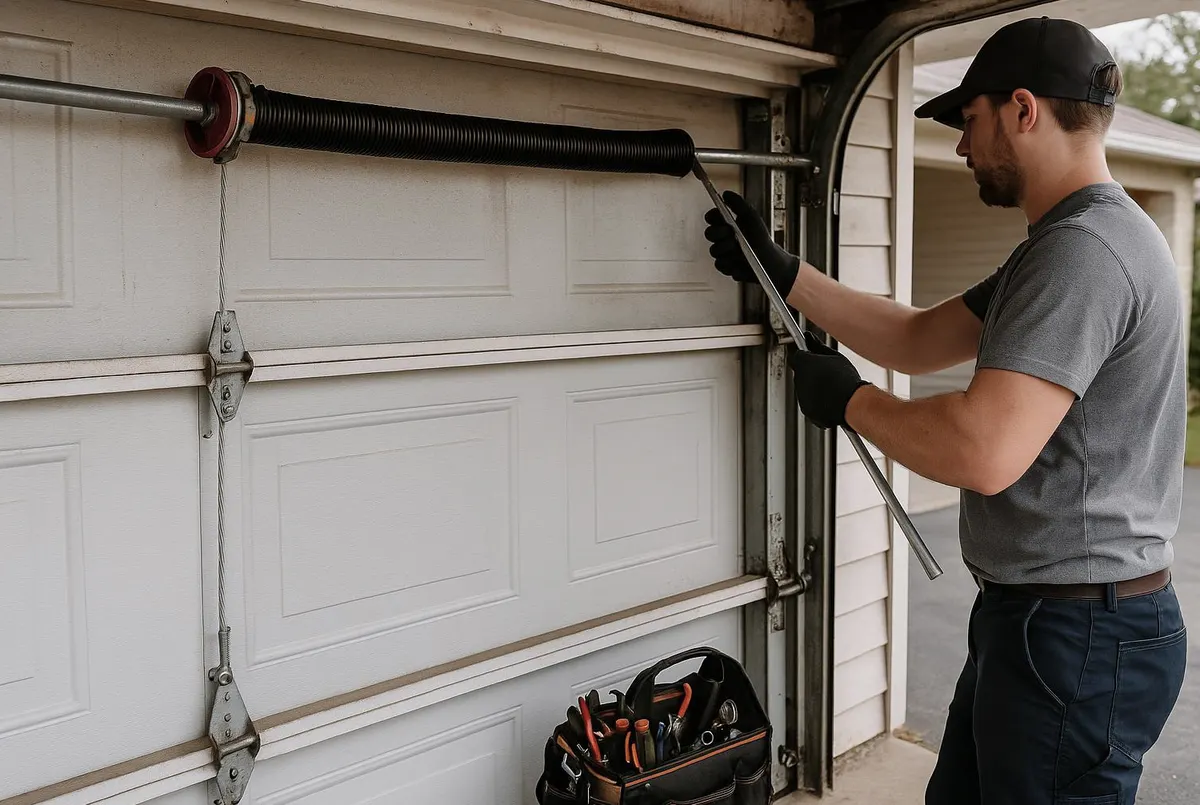
The Moment You Notice It
It usually starts small. You hit the opener button and the door groans halfway up, then stops. Or you walk past the garage and hear a loud bang, like a gunshot, followed by the door hanging crooked on one side. Maybe you just notice the door feels heavier than it used to when you lift it by hand, or one cable looks slack and frayed near the bottom bracket. In every one of these moments, the instinct is the same: grab a wrench, look up a video, and fix it before dinner. That instinct is exactly what sends people to the emergency room.
What's Actually Under Tension
A standard garage door spring, whether it's a torsion spring mounted above the door or the extension springs running along the horizontal tracks, is wound so tight it can lift 200 to 400 pounds of door with a twist of a wrench. That stored energy doesn't care whether you're a professional or a homeowner with a socket set. When a spring that's under tension slips, over-winds, or simply fails mid-adjustment, it releases all at once. The coil can whip free of the shaft, the winding bar can fly out of your hands, and the door itself, no longer supported, can drop fast.
The injuries that show up at local ERs after a DIY spring job follow a short, predictable list:
- Crushed or broken fingers caught between coils as a spring unwinds unexpectedly
- Facial and eye injuries from a winding bar or cable snapping back
- Deep lacerations from sharp, frayed cable wire under load
- Broken bones or worse when an unsupported door falls on someone reaching underneath it
None of these require a freak accident. They happen during routine, careful work, because torsion spring force is simply more than human reflexes can outrun.
Why This Part of Alabama Makes It Worse
Garage door springs in this region don't fail the same way they might in a dry climate. The humidity around Selma, Orrville, and Valley Grande keeps metal hardware damp for much of the year, and that moisture works its way into spring coils, cable strands, and the galvanized coating meant to protect them. Add hurricane-season downpours and the swelling wood or warped panels common in older garages here, and you get springs that are already fighting rust and uneven load before anyone touches a wrench. A spring with surface rust can look fine and still be dangerously weakened, which means it can fail at a lower force than a clean one would, often with less warning.
Wind-load considerations matter here too. Many garage doors installed or replaced in this area are rated for specific wind pressures because of storm season, and that rating depends on the whole system, track, springs, and reinforcement, working together as designed. Swapping in a mismatched spring or improvising a repair can quietly undo that wind rating without you ever knowing it, until a storm puts real pressure on the door.
What Prevents the Injury (Not Just the Breakdown)
You don't need to become a technician to protect yourself. You need to recognize which jobs are genuinely dangerous and which are safe to handle.
Safe for a homeowner:
- Visually inspecting springs and cables for rust, fraying, or gaps in the coil
- Lubricating hinges, rollers, and tracks with a garage-door-specific lubricant
- Tightening visible bolts on the track or opener bracket
- Testing the auto-reverse safety feature by placing a block in the door's path
Not safe for a homeowner:
- Loosening, tightening, or replacing a torsion or extension spring
- Removing the spring cone or adjusting winding cones with a standard wrench
- Replacing lift cables under tension
- Attempting to force open a door that's stuck because a spring has already broken
If a spring has already snapped, the safest move is to leave the door exactly where it is. Don't try to pull it down or prop it open. If it's blocking a car inside, that's an inconvenience, not an emergency, compared to what happens if the door drops while someone is underneath it. Keep kids and pets away from the area, and resist the urge to disconnect the opener and pull the emergency release, since that can cause an unsupported door to fall immediately.
When to Call Selma Garage Door
If you hear that bang, see a gap in a coiled spring, or notice the door suddenly feels twice as heavy, it's time to call rather than troubleshoot. Our Spring Replacement service uses properly rated springs matched to your door's weight and your home's wind-load needs, not a generic size grabbed off a shelf, and we handle the winding and tensioning with the specialized bars and clamps built for it. If the failure has also thrown off your opener or left tracks bent, we pair that with our Garage Door Repair service to get everything moving safely again in one visit. And if your springs are original to a home in Selma, Marion, or Camden and showing rust from years of humidity, our Garage Door Maintenance checks catch weakening springs before they fail at the worst possible moment, like mid-storm with the car halfway out.
A garage door spring problem is one of the few repairs where the smart move and the safe move are the same thing: step back and let someone trained for it handle the tension. If your door is stuck, sagging, or you just heard that unmistakable bang, call Selma Garage Door today for fast, reliable service throughout Selma, Alabama and the surrounding communities.